
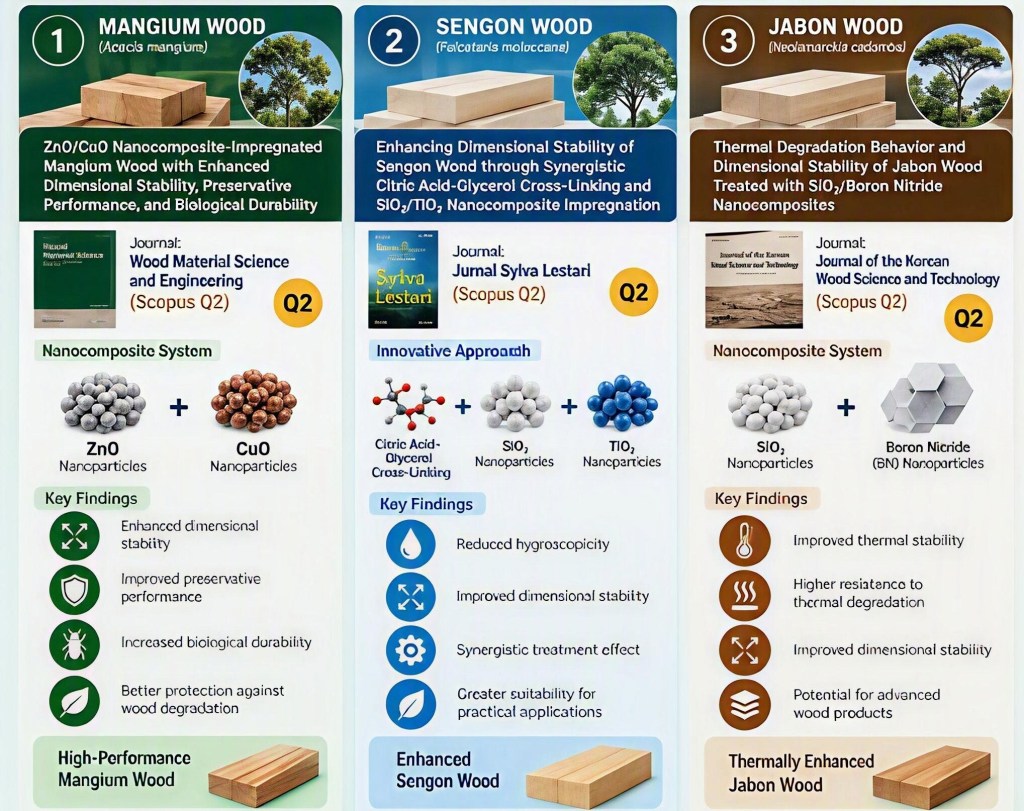
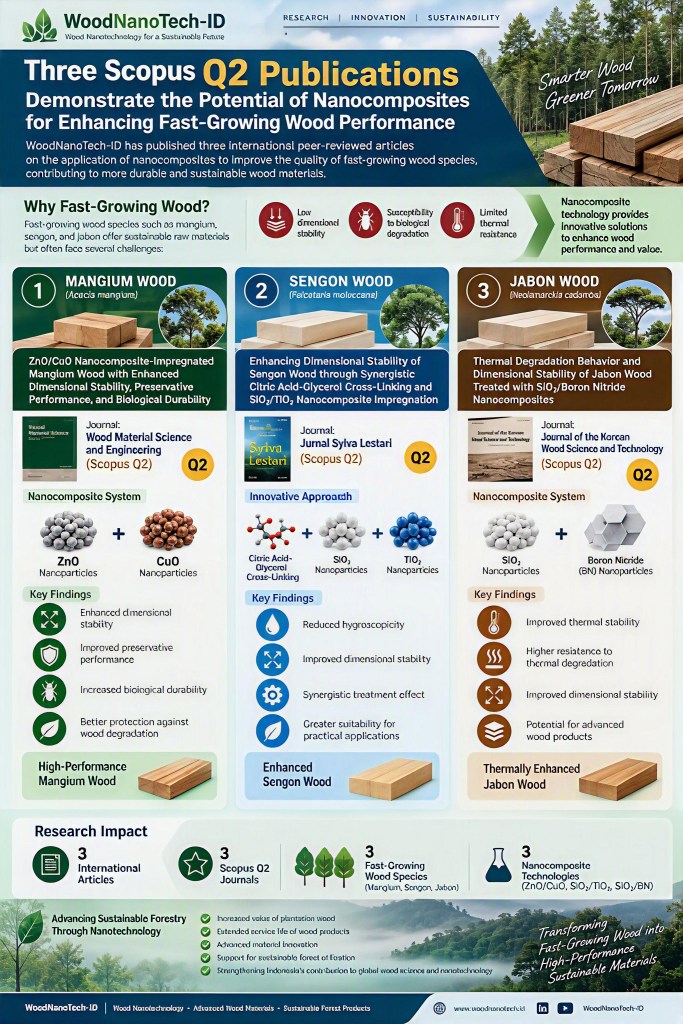
Bogor, Indonesia – The WoodNanoTech-ID research team continues to strengthen its contribution to sustainable wood science through the publication of three international peer-reviewed articles focusing on the application of nanocomposite technologies to improve the quality and performance of fast-growing wood species. Published in reputable Scopus Q2-indexed journals, these studies demonstrate innovative approaches to enhancing dimensional stability, biological durability, preservative performance, and thermal resistance of plantation-grown timber.
Addressing the Challenges of Fast-Growing Wood
Fast-growing wood species such as mangium (Acacia mangium), sengon (Falcataria moluccana), and jabon (Neolamarckia cadamba) play an increasingly important role in sustainable forestry and the wood-based industry due to their rapid growth rates and high productivity. However, their wider utilization is often constrained by inherent drawbacks, including poor dimensional stability, susceptibility to biological degradation, and limited thermal performance.
To address these challenges, the WoodNanoTech-ID team has explored the use of advanced nanocomposite systems designed to interact with the wood cell wall structure and improve key physical and functional properties.
1. ZnO/CuO Nanocomposites for Enhanced Performance of Mangium Wood
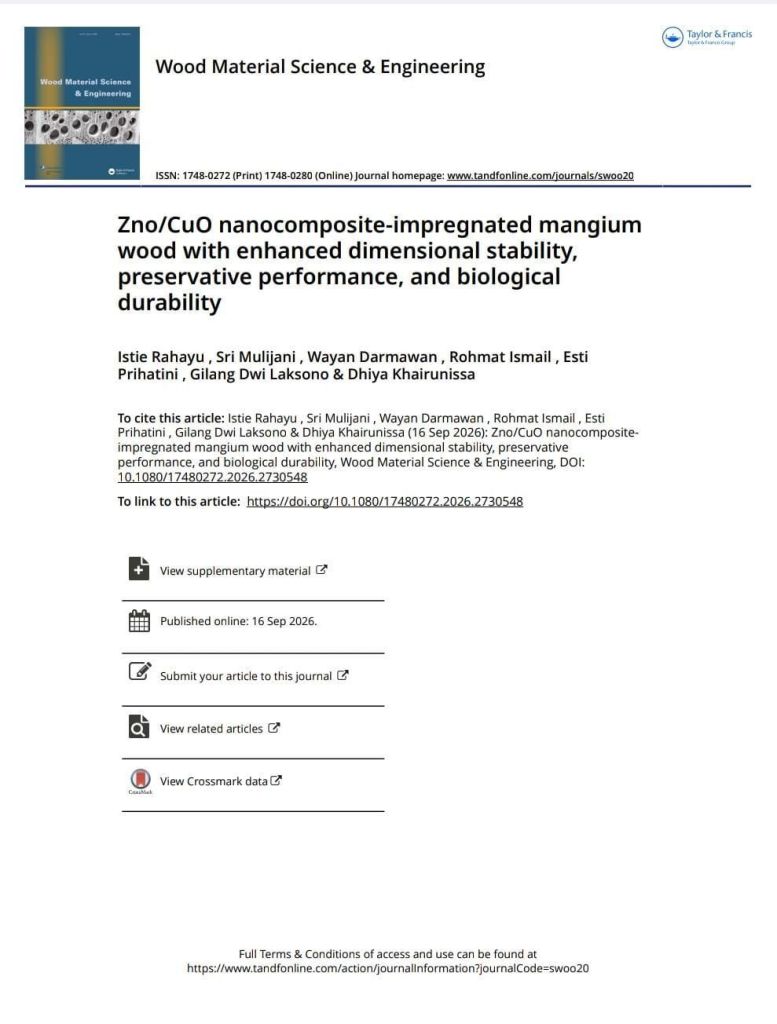
The first article, entitled:
was published in Wood Material Science and Engineering (Scopus Q2).
This study investigated the impregnation of mangium wood with ZnO/CuO nanocomposites and evaluated their effects on wood performance. The results demonstrated that the nanocomposite treatment significantly improved dimensional stability while simultaneously enhancing preservative efficacy and biological durability. The synergistic interaction between zinc oxide and copper oxide nanoparticles contributed to improved protection against degradation factors, highlighting the potential of nanotechnology-based wood preservation systems.
Key findings include:
- Improved dimensional stability under moisture fluctuations.
- Enhanced preservative performance and retention.
- Increased resistance to biological deterioration.
- Potential for developing environmentally responsible wood protection technologies.
2. Synergistic Cross-Linking and SiO₂/TiO₂ Nanocomposite Treatment of Sengon Wood
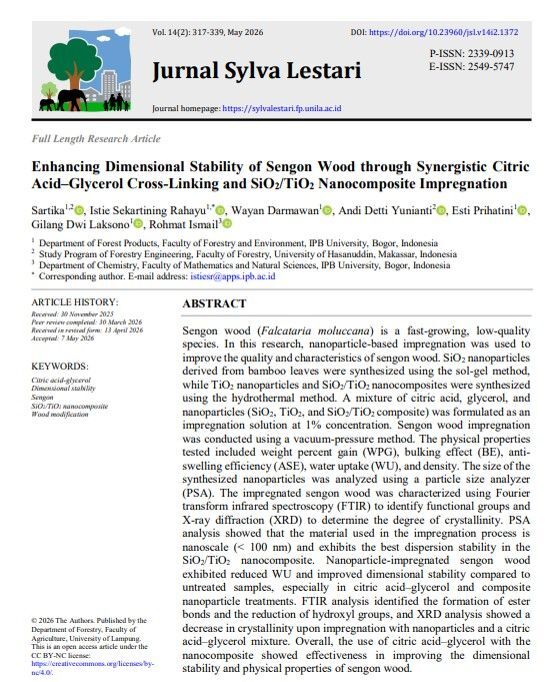
The second article, entitled:
was published in Jurnal Sylva Lestari (Scopus Q2).
This research combined two complementary modification strategies: citric acid-glycerol cross-linking and SiO₂/TiO₂ nanocomposite impregnation. The approach aimed to reduce the hygroscopic nature of sengon wood, which is a major factor affecting dimensional instability.
The study revealed that the combined treatment outperformed individual modification methods. The interaction between the cross-linked polymer network and the nanocomposite particles effectively reduced moisture-induced dimensional changes, resulting in significantly improved dimensional stability.
Key findings include:
- Significant improvement in wood dimensional stability.
- Superior performance of the combined treatment compared with single-treatment approaches.
- Utilization of relatively environmentally friendly modification agents.
- Strong potential for industrial applications of modified plantation wood.
3. SiO₂/Boron Nitride Nanocomposites for Thermal and Dimensional Enhancement of Jabon Wood
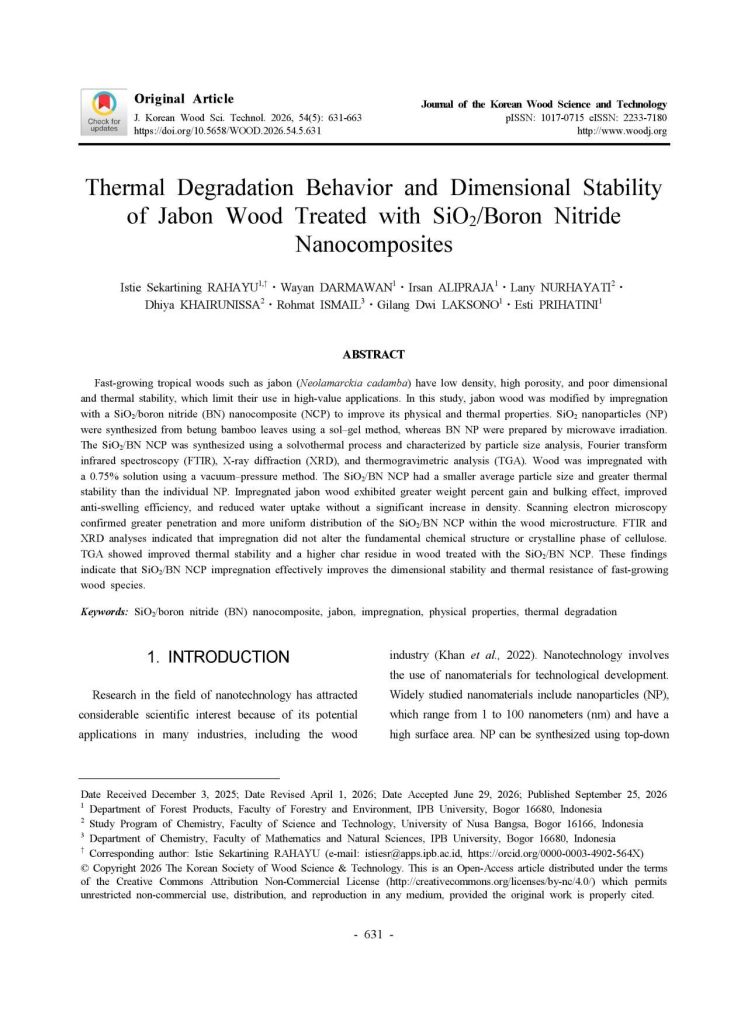
The third article, entitled:
was published in the Journal of the Korean Wood Science and Technology (Scopus Q2).
This study focused on improving the thermal performance and dimensional stability of jabon wood through treatment with SiO₂/boron nitride (BN) nanocomposites. Boron nitride is widely recognized for its excellent thermal stability, and its combination with silica created a functional nanocomposite capable of enhancing the thermal resistance of wood.
Thermogravimetric analysis demonstrated improved resistance to thermal degradation, while dimensional stability assessments indicated reduced susceptibility to environmental changes. These results suggest that SiO₂/BN nanocomposites offer promising opportunities for advanced wood applications where thermal performance is critical.
Key findings include:
- Enhanced thermal stability and resistance to thermal degradation.
- Improved dimensional stability.
- Greater suitability for applications exposed to elevated temperatures.
- Expanded opportunities for developing high-performance wood products.
Advancing Sustainable Wood Materials Through Nanotechnology
Collectively, these three publications highlight the growing role of nanotechnology and advanced material engineering in overcoming the limitations of fast-growing wood species. By enhancing durability, dimensional stability, and thermal performance, nanocomposite-based treatments can increase the value and service life of plantation timber while supporting more efficient and sustainable utilization of forest resources.
These achievements reflect the ongoing commitment of WoodNanoTech-ID to advancing research in wood nanotechnology, sustainable wood modification, and advanced forest products. Through innovative and interdisciplinary research, the team continues to contribute to the development of high-value, environmentally responsible wood materials and to strengthen Indonesia’s presence in the global scientific community.As WoodNanoTech-ID moves forward, it remains dedicated to exploring cutting-edge solutions that bridge nanotechnology, materials science, and forestry to meet the evolving demands of sustainable wood-based industries.


Leave a Reply